Gas dispersion and buoyancy simulation, live in 3D
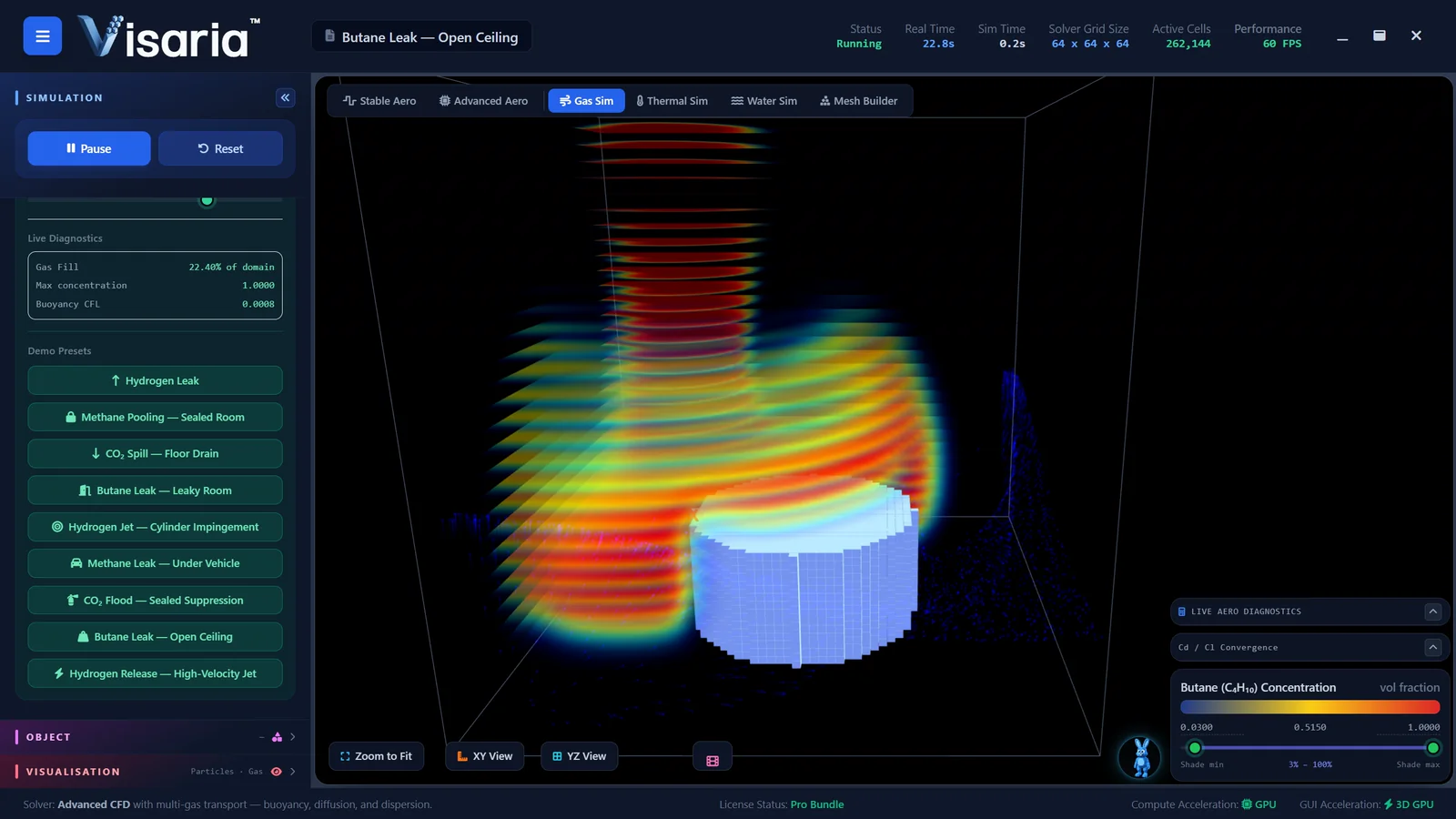
Watch a gas leak rise, sink and spread. Visaria's Aero and Gas solver shows buoyancy, mixing and dispersion in airflow as it happens, with the gas entry, flow rate and wind all adjustable while it runs.
Why gases behave the way they do
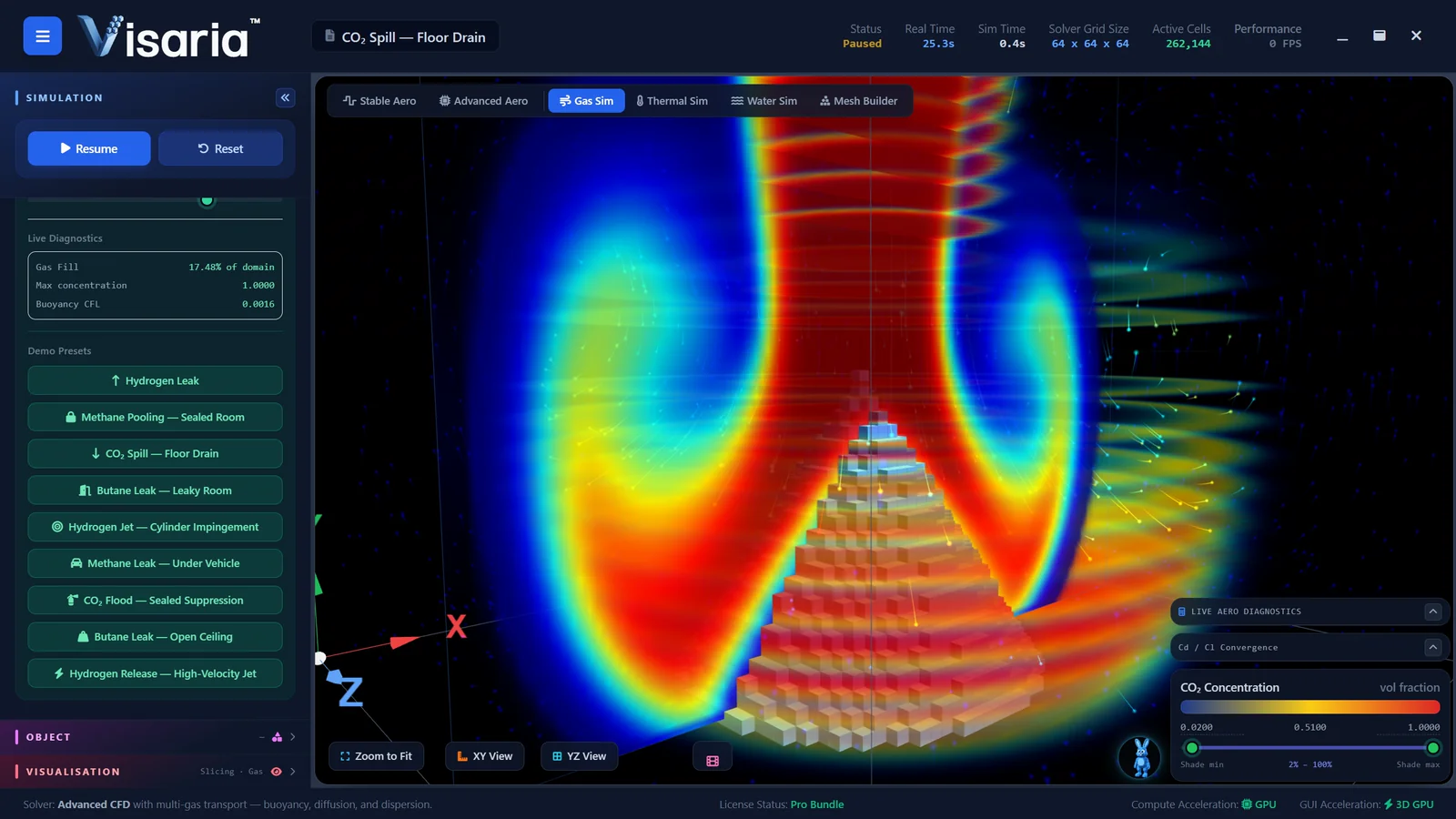
A gas that is lighter than the surrounding air tends to rise, and one that is heavier than air, such as butane or carbon dioxide (CO2), tends to sink and spread along the floor. How fast it does so depends on the difference in density, how quickly it is released, and the air currents around it, because a draught can carry, bend or break up a plume. It is easy to say this in a sentence and surprisingly hard to predict by intuition for a particular room or opening.
The Aero and Gas solver lets you try it. Choose a gas, set where it enters and how fast, add some wind, and watch the plume develop in 3D. Learning Hub topics such as how powerful buoyancy is walk you through the idea and link to a scenario you can change.
What you can do with it
- See the effects of different gases and flow conditions on your geometry set-up. Ready-made scenarios include a hydrogen leak, methane pooling in a sealed room, a CO2 spill and a butane leak.
- Adjust boundary conditions, gas entry positions, flow rate and velocity and watch the results live.
- Compare a gas that is lighter than air with one that is heavier than air by changing the gas and running again.
- Add obstacles, with shapes built in the Mesh Builder or imported as STL files, and see how they trap, split or deflect the plume.
Not a safety tool
Visaria uses a coarse voxel grid and solvers tuned for real-time use, so what it shows is indicative. It does not model combustion, fire or explosions. Do not use it for gas leak risk assessment, ventilation design or any decision where safety depends on an accurate answer. For those, use validated tools and qualified people. Visaria is for understanding what gas does, so that you are better prepared to ask the right questions.
The Aero and Gas solver is included in the free 7-day trial and in the Pro Bundle, and can be bought on its own. See pricing.
What you need to run it
Visaria runs on Windows and needs a dedicated graphics card: an NVIDIA GeForce GTX 1050 or AMD Radeon RX 560 is the minimum, and an RTX 2060 or RX 5600 XT or better is recommended, with an 8th-generation Intel Core i5 (or equivalent) and 8 GB of memory. Mac and Linux versions are coming soon. The free trial is the quickest way to check that it runs well on your computer.
Questions about gas simulation in Visaria
Can I use it for gas leak risk assessment?
No. Its results are indicative, not validated, and it does not replace a proper assessment. Use it to learn how plumes behave, not to decide what is safe.
Can it show how CO2 collects in a room?
It can show how a heavier-than-air gas spreads and settles in airflow around your geometry. Treat it as a way to see the behaviour, not as a prediction of concentrations.
Can it simulate smoke?
It shows how a buoyant plume of gas rises, spreads and mixes in airflow, which is related, but it does not model combustion, fire or the production of smoke. It is not a smoke or fire simulator.
Does it simulate fire or explosions?
No. It covers gas buoyancy, mixing and dispersion in airflow, not combustion.
Can I change the wind and the leak while it runs?
Yes. Gas entry positions, flow rate and velocity can be adjusted live, and you see the effect immediately.
Is there a free trial?
Yes. The free 7-day trial has no payment card and includes the Gas solver. Request a trial key.
Keep exploring
Or see all the features, the Learning Hub and the gallery.
Watch gas rise, sink and spread
The free 7-day trial needs no payment card and includes the Aero, Gas, Thermal and Water solvers.